How to Know If Your Hair Is Thick or Fine
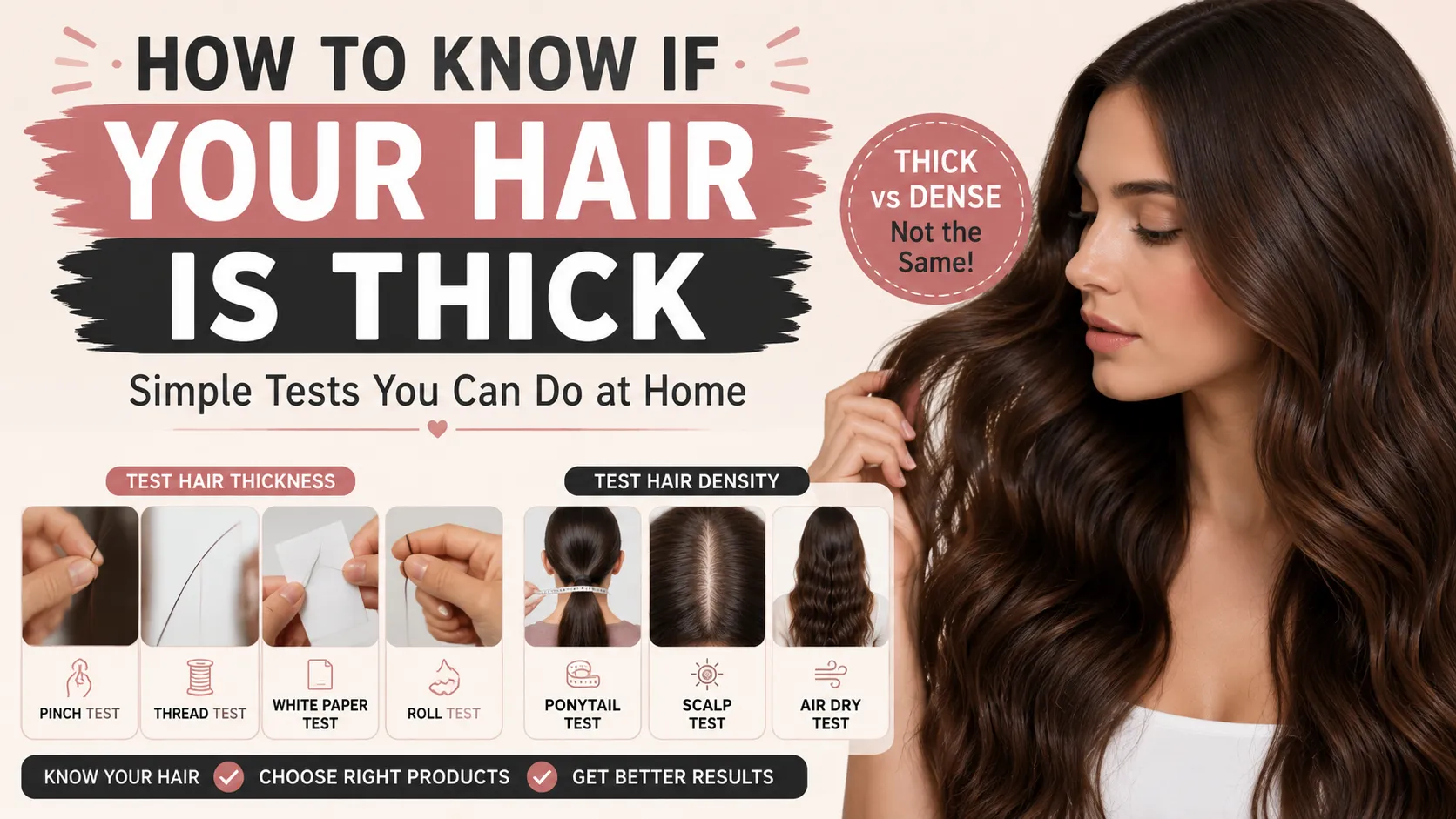
Most people believe they have thick hair but that’s not always true.
Sometimes your hair only looks thick because there’s a lot of it. Other times, the strands themselves are actually thick. These are two completely different things, and mixing them up is one of the biggest reasons people struggle with their hair.
Before you try any tests, you need to understand one key idea that changes everything.
Thick vs Dense — They Are Not the Same Thing
There are two main factors that define your hair:
Strand thickness is about how wide each individual strand is.
If you can easily feel a single strand between your fingers, it leans toward thick. If it feels almost invisible, it’s fine.
Hair density is about how many strands grow on your scalp.
You can have thin strands but a lot of them, which makes your hair look full. Or you can have thick strands but fewer of them, which can make your hair look flatter than expected.
This is why just looking in the mirror is not enough. You need to test both thickness and density to understand your real hair type.
Quick Check
If you want a fast idea before doing full tests, try this:
- Can you clearly feel one strand? → likely thick strands
- Does your ponytail feel small? → lower density
- Can you easily see your scalp? → lower density
This won’t give you a complete answer, but it gives you a strong starting point.
How to Test Strand Thickness
These tests help you understand how thick each individual strand is.
1. The Pinch Test
Pull out one strand of hair and place it between your thumb and finger.
- If you can barely feel it → fine hair
- If you clearly feel the strand → thick hair
This is one of the easiest and most reliable tests you can do at home.
2. The Thread Test
Take a regular sewing thread and place your hair next to it in good lighting.
- If your hair looks thinner → fine
- If it looks similar or thicker → thick
This gives you a simple visual comparison without needing any tools.
3. The White Paper Test
Hold one strand against a white background.
- If it almost disappears → fine
- If it shows clearly → thick
This works best when combined with the pinch test.
4. The Roll Test
Roll the strand between your fingers.
- If it slips easily → fine hair
- If it feels slightly firm or resistant → thick hair
This test is less precise but still helpful when used with others.
How to Test Hair Density
Now it’s time to figure out how much hair you actually have on your scalp. This is called density, and it plays a big role in how full or flat your hair looks.
The best way to understand it is by using a few simple checks together instead of relying on just one.
1. The Ponytail Test
Tie your clean, dry hair into a tight ponytail without using any styling products. Then look at the thickness of the ponytail or measure around it.
- Under 2 inches → low density
- 2 to 3 inches → medium density
- Over 3 inches → high density
This gives you a rough idea of how much hair is growing on your scalp.
Keep in mind, this method is not perfect. Hair length, layers, and curl pattern can change how thick your ponytail looks. Still, it’s one of the easiest ways to estimate density at home.
2. The Scalp Visibility Test
Stand under bright lighting and look closely at your scalp, especially along your part line and crown.
- If you can clearly see spaces between strands → lower density
- If your scalp is mostly covered → higher density
Try to check your hair in its natural state without heavy oils or styling products, as these can make your hair clump together and give a false result.
This is one of the most commonly used methods because it shows how closely your hair actually grows on your scalp.
3. The Natural Volume Test
Wash your hair and let it dry completely without applying any products. Just let it fall naturally.
- If your hair lies flat and your scalp shows through → lower density
- If your hair keeps some lift and looks full → higher density
This test helps you see how your hair behaves without outside influence.
However, be careful with this one. Hair texture can affect the result:
- Wavy or curly hair may look fuller than it really is
- Straight hair may look flatter even if density is medium
So it’s best to use this test along with the others, not alone.
Important Tip
No single test gives a perfect answer.
For the most accurate result, combine:
- ponytail size
- scalp visibility
- natural volume
When all three point in the same direction, you can be much more confident about your hair density.
What Your Results Mean Together
Once you know both your strand thickness and density, combine them to understand your hair properly.
1. Fine Strands + High Density
Your hair may look full, but each strand is delicate. It can lose volume quickly if you use heavy products. Breakage can also be more common if not handled gently.
2. Fine Strands + Low Density
Hair may look thin overall. It needs lightweight products that add lift without making it heavy or greasy.
3. Thick Strands + High Density
This is what most people imagine as “thick hair.” It feels full and heavy, can take longer to dry, and may be harder to style. It often needs shaping and layering to manage bulk.
4. Thick Strands + Low Density
Your strands feel strong, but your hair may not look very full. The goal here is to add volume without making the hair feel weighed down.
Why Knowing This Actually Matters
Knowing whether your strands are truly thick or just appear full can completely change how you care for your hair. Small mistakes in this area often lead to frustrating results.
1. Choosing the Right Products
Not all products work the same on every hair type.
Rich creams, heavy oils, and thick styling products are usually better suited for stronger, thicker strands. If your hair is actually fine, these products can quickly make it look flat, greasy, or lifeless.
When you understand your strand type, you naturally choose formulas that work with your hair instead of against it.
2. Getting the Right Haircut
Haircuts depend a lot on how thick your strands really are.
If a stylist assumes your hair is thick when it’s actually fine but dense, they might remove too much weight. This can leave your hair looking limp and harder to style.
On the other hand, if thick hair is treated like fine hair, it may not get enough shaping, which can make it feel heavy and difficult to manage.
3. Better Styling Results
Different hair types react differently to styling tools and techniques.
Fine strands can be more sensitive and may get damaged faster with heat. Thick strands usually need more effort and stronger hold to keep a style in place.
Using the wrong method often leads to styles that don’t last or worse, long-term damage.
4. Smarter Hair Care and Treatments
Your strand thickness also affects how your hair responds to treatments.
Thicker strands can usually handle richer conditioning treatments, oils, and masks. Fine strands, on the other hand, often need lighter care and sometimes benefit more from strengthening treatments rather than heavy moisture.
Matching your routine to your hair type helps keep it healthier over time.
5. Setting the Right Expectations
Understanding your hair type helps you avoid disappointment.
For example, if your hair is fine but you have a lot of it, using heavy “thick hair” products may not give you the results you expect. Instead of adding volume, they may weigh everything down.
When you know your hair’s true nature, you choose products and styles that actually enhance it rather than trying to force it into something it’s not.
What Can Change How Your Hair Feels
Your hair type is mostly natural, but some things can change how it behaves:
- Heat damage can make strands feel rough or thicker
- Chemical treatments can weaken or alter texture
- Humidity can make hair look fuller or flatter
- Product buildup can make hair feel heavier than it is
This is why it’s a good idea to test your hair again if your routine or condition changes.
Common Mistakes to Avoid
- Assuming full hair means thick strands
- Using heavy products without testing your hair type
- Skipping layers when your hair needs shape
- Copying styles without considering your hair structure
Quick Summary
- Thickness = how wide each strand is
- Density = how many strands you have
- Use pinch, thread, and paper tests for thickness
- Use ponytail and scalp checks for density
- Combine both results for a clear understanding
- Choose products and styles based on your actual hair type
FAQs
1. How do I know if my hair is thick or thin?
Check a single strand using the pinch or thread test, if you can feel or see it clearly, it’s thick; if not, it’s fine.
2. How can I tell my hair density at home?
Tie a ponytail and check its size or look at your scalp in bright light to see how much hair is covering it.
3. Why does my hair look thick but feel thin?
This usually means you have high density (many strands) but fine individual hairs, which creates a fuller look.
Final Thought
Once you understand your hair properly, everything becomes easier.
You stop guessing.
You stop wasting money on the wrong products.
And you start choosing styles and routines that actually work for you.
That’s when your hair starts to feel manageable, predictable, and easier to style every day.
Read More : 11 Simple Tips to Fix an Oily Scalp Naturally
Read More : 12 Hidden Causes of Dandruff (Most People Ignore)